Friday, March 16, 2012

Yo-Yo And Byron's First Birthday

Dear Byron,

Only a couple days now and you'll be ONE YEAR old! Wow! Where did the year go?

I've been pondering what I might get you for your birthday. This may sound crazy, but I actually thought about getting you a very, very old toy that has nothing to do with modern day electronic gadgets. I'm talking about a yo-yo! I had lots of yo-yos when I was a kid.

The Yo-Yo came to the USA only a couple years before I was born. There's even a National Yo-Yo Museum in the northern California town of Chico. They have the world's biggest collection of yo-yos from around the world. Here's a picture from their website of the "Big-Yo", the 1982 Guinness Book of World's Records largest working wood yo-yo, weighing 256 lbs.


The yo-yo as a toy (known as a bandalore) had been used for centuries. It may be the second oldest toy in the world (after dolls). There are ancient Greek yo-yos made of terra cotta in museums in Athens and yo-yos are pictured on the walls of Egyptian temples. The yo-yo was popular with such important warriors as Napoleon and the Duke of Wellington. It was first patented in 1866 by James L. Haven and Charles Hettrich. The word yo-yo is actually a Tagalog word, the native language of the Philippines, and means 'come back.'

Pedro Flores was the single, most important person to introduce the word 'yo-yo' to the United States. Flores was a native of Vintarilocos Norte, Philippines. He came to the United State in 1915. He attended the High School of Commerce in San Francisco 1919-1920. Then he took up the study of Law at the University of California - Berkeley and the Hastings College of Law in San Francisco. 

He later dropped out of school, had a variety of jobs and developed his vision for the yo-yo's potential when he read about a man selling a ball attached to a rubber band, who made a million dollars. He remembered the game yo-yo which was played for hundreds of years in the Philippines and he thought it had a good market possibility in the U.S. Mr. Flores was quoted saying, "I do not expect to make a million dollars; I just want to be working for myself. I have been working for other people for practically all my life and I don't like it." 

In early 1928 Flores went to Los Angeles and asked a wealthy Philippine for assistance in manufacturing yo-yos. His friends thought him crazy and he returned to Santa Barbara with only his dream. Being a true entrepreneur, at the age of 29, on June 9th, 1928, he applied and received a certificate of conducting business for the Yo-yo Manufacturing Company in Santa Barbara. On June 23, 1928, he made a dozen yo-yos by hand and began selling them to neighborhood children. 

From those humble beginnings, the yo-yo went on to became a national craze, with contests everywhere. Flores later sold his interest in his yo-yo manufacturing companies for more that
$250,000, an absolute fortune in the days when I was a little kid.

Donald F. Duncan was the guy who bought out Flores' companies and the name yo-yo. He introduced the looped slip-string, which allows the yo-yo to sleep—a necessity for advanced tricks. During the 1950s, Duncan introduced the first plastic yo-yos and the Butterfly® shaped yo-yo, which is much easier to land on the string for complex tricks.

Maybe in a few years I'll really get you a yo-yo and you can enter yo-yo competitions. Who knows? You might even become national yo-yo champion. 

Well, just a thought. Maybe for now we'll get you a toy easier to play with. In any event, we're all giving thanks for this first wonderful year. 

God bless and keep you, dear Great-Grandson! 

Love ya, 

GGPa

Friday, March 9, 2012

Sunday Is No Longer The Day Of Rest

Dear Byron,

A couple days ago, I heard from your daddy that he, your mommy and you will soon be moving to the city where GGMa and I live, because your daddy has a new job here. Needless to say, we're excited. We'll get to see you a lot more than we have during this past year. As I've noted earlier, things are always changing. Today I'd like to tell you how weekends have changed since I was your age.

When I was a kid growing up in Minnesota in the 1930s and 40s, Sunday was a 24-hour stretch of family time when liquor was unavailable, church was the rule and shopping was impossible. Instead of working on Sunday afternoons we'd go visit some of our relatives and friends. Of course, being farmers, we still had to care for the animals and milk the cows, but generally speaking, Sunday was a day of rest for the entire family.

Laws enforcing the use of Sunday or the Sabbath were called "blue laws." The first occurrence of the phrase blue law was found in the New-York Mercury of March 3, 1755, where the writer imagines a future newspaper praising the revival of "our Connecticut's old Blue Laws". The term "blue laws" originally applied to laws enacted by the Puritans in seventeenth-century Connecticut to regulate moral behavior (especially what people must or must not do on the Sabbath), laws which often called for rather harsh punishments to be applied to offenders. Blue laws typically specified penalties for moral offenses such as failure to attend church on the Sabbath; lying, swearing, and drunkenness; and the playing of games (such as cards, dice, and shuffleboard) in public.

They also made laws with severe punishments for crimes committed on the Sabbath and regulated the sale and consumption of alcohol. Violators of blue laws might be assessed monetary fines, be whipped, be forced to spend time in the stocks, have body parts burned or cut off, or even receive the death penalty.

But America has changed, and it dragged Sunday and the blue laws along with it. Although Sunday still means worship and family time for millions of Americans, today it also means things it once didn't back in my youth—12-packs of Bud, the NFL on TV, catching up with the week's accumulated errands, kids' soccer games, shopping for Apple's latest iPad at the mall and moving through a 24/7 culture.

"Today, for a lot of Americans, Sunday's just another day you have to go to work at Wal-Mart," said John Hinshaw, a labor historian at Lebanon Valley College in Annville, Pa. The Protestant notion of Sunday as a day of rest began to change in the 1800s with immigrant laborers, many Roman Catholic, who saw things differently. Many were devoted to "a Sunday that took a very different shape: church in the morning and leisure in the afternoon," said Alexis McCrossen, author of "Holy Day, Holiday: The American Sunday," published in 2002 by Cornell U. Press.

The 20th century brought pushes toward a shorter workweek, and a major work-reform law passed in the 1930s created more down time. This made Sunday like every other day. As a result, commercial culture really took hold of it, as it had on the other six.

Today, 37 states permit Sunday sales of liquor, according to the Distilled Spirits Council of the United States. The Council boasts, "Reforming outdated Sunday sales restrictions on distilled spirits has been one of the Distilled Spirits Council’s most successful legislative initiatives at the state level. Since 2002, 15 states have joined the list of states allowing Sunday sales: Arkansas, Colorado, Delaware, Georgia, Idaho, Kansas, Kentucky, Massachusetts, New York, Ohio, Oregon, Pennsylvania, Rhode Island, Virginia, and Washington." Notice that the list includes Massachusetts, where some of the earliest moral-conduct laws were passed. My own growing-up state, Minnesota, is still working on the idea. All four surrounding states allow it.

We have erased the older distinctions between workdays and the day of rest. The Bible gives us a long history of how the original Israelites were forbidden to work on the Sabbath or Saturday, the seventh day. I've published a study of that topic. I've titled it Day of Rest. In my short book I suggest that we all have a lot to learn from the Third Commandment and the laws that grew out of it. Of course, we Christians are not bound by those laws since they are but a shadow of all the true rest and peace that is ours in the Lord Jesus (Col. 2:16-17).

A while back I read that People's United Bank in Bridgeport, Conn.—a bank—focused an entire promotional campaign on Super Bowl Sunday. Well Byron, you'll soon learn about the importance of Super Bowl Sunday. I'm hoping and praying that you and your family will be able to join us on the next Super Bowl Sunday at church. And then, after a relaxing Sunday dinner, we can all watch the big football game on the TV together. I pray that the importance of family worship and being together never goes away regardless of how Sundays and weekends change.

All our love,

GGPa

Thursday, March 1, 2012

Ain't We Got Fun

Dear Byron,

It won't be long before you'll start talking. We are, after all, about to celebrate your first birthday. And we're all excited. In fact, we've been keeping a photo record of that first year. We in your family believe you'll appreciate it as you grow older. You will look back and laugh with us about all those things.

As you can tell by this time, I love to look back. I think it helps all of us to look ahead. Today again I'm looking back with you at how much things have changed since I was your age.

Here's some numbers from 1930-39, the decade in which I grew up, compared to the present.

Population in the United States
Then: 123,188,000 of us lived in 48 states.
Now: We are over 311,600,000 — nearly 3 times as many. About 6.5% of us are your age, with twice that number over 65. White folks, not Hispanic, are over 60%, but that's rapidly changing. People of Latino origin are over 16%. Black folks are nearly 13%. 
Life expectancy
Back in the 1930s men expected to live to about 58 on average and women to about 62.
Now they tell us you can expect to live over 78 years—if you live in Minnesota where I grew up. Here in Texas we only expect to live to about 76. Hah! I'm glad I was born in Minnesota, because I'm past that. Some say that your GGPa will make it to 82 since I've lived this long. We'll see. That's all in our Lord's hands. Of course, if you ever have a little sister she'll likely live on average to well over 80. Who knows? With all the advances in medical science, by the time you're all grown up you and others of your generation may live to be over 100. 
 Annual income
I think I told you that back in the 1930s people were having a hard time making money. Here's some samples. On average a worker made a little over $1,360 a year. Yup, a year! If you worked in a factory you made under $17 a week. A cook earned $15 and even a medical doctor only cleared about $61 a week. That was less than $3,200 a year for the doc and the cook was lucky to make $760 in the same year. 
Today the median annual household income is about $50,000. It'll be about 3, even 4 times that in your house, because both of your parents have advanced college degrees and work. That'll put your family in the upper 2-3%. The earnings gap between those with college degrees and those with only high school is getting wider and wider all the time. During the past generation (while your folks were growing up) the high school folks' income rose 10% at most, while the income of people with advanced degrees rose by over 30%.
Unemployment
Remember me saying that the 1930s decade was called the Great Depression? Everything was depressed. Unemployment was around 25% for much of those 10 years. No matter how little people made, a fourth of us made nothing at all! Despite all the things the Government did, it was still over 17% in 1939. 
Today we're going through what people call a recession, not a depression. So 4-5 years ago only about 5% of us were unemployed in the United States. Today we still have 28 million unemployed. That includes people who only can get part-time jobs, but have given up finding a permanent one. As I write we still have 9.5% unemployed. In some areas its over 10% yet. We're all praying that somehow that will change.
How much things cost
This part is fun—and strange. Here are the prices of some things when I was a kid

  • Quart of milk - 14 cents
  • Loaf of bread - 9 cents
  • 5 pounds of flour - 25 cents
  • Dozen of eggs - 38 cents
  • Pound of round steak - 42 cents
  • Sweater - $1.00 
  • Table lamp - $1.00
  • Gas stove - $20
  • Portable electric sewing machine - $24
  • Heavy winter coat - $28
  • New car - $625
  • Gasoline - 19 cents per gallon
Yes, Byron, things have changed a lot during the three generations since I was born. In spite of all the problems people had in those days they could still laugh and make fun of themselves. One of those satirical songs was called 
Ain't we got fun 
Bill collectors gather 'round and rather Haunt the cottage next door Men the grocer and butcher sent Men who call for the rent But within a happy chappy And his bride of only a year Seem to be so cheerful, here's an earful Of the chatter you hear Ev'ry morning, ev'ry evening Ain't we got fun? Not much money, Oh, but honey Ain't we got fun? The rent's unpaid dear We haven't a bus But smiles were made dear For people like us In the winter in the Summer Don't we have fun Times are bum and getting bummer Still we have fun There's nothing surer The rich get rich and the poor get children In the meantime, in between time Ain't we got fun? Just to make their trouble nearly double Something happened last night To their chimney a gray bird came Mister Stork is his name And I'll bet two pins, a pair of twins Just happened in with the bird Still they're very gay and merry Just at dawning I heard Ev'ry morning, ev'ry evening Don't we have fun Twins and cares, dear, come in pairs, dear Don't we have fun We've only started As mommer and pop Are we downhearted I'll say that we're not Landlords mad and getting madder Ain't we got fun? Times are so bad and getting badder Still we have fun There's nothing surer The rich get rich and the poor get laid off In the meantime, in between time Ain't we got fun? When the man who sold 'em carpets told 'em He would take them away They said, "Wonderful, here's our chance Take them up and we'll dance" And when burglars came and robbed them Taking all their silver, they say Hubby yelled, "We're famous, for they'll name us In the pepers today Night or daytime, it's all playtime Ain't we got fun? Hot or cold days, any old days Ain't we got fun If Wifey wishes To go to a play Don't wash the dishes Just throw them away Streetcar seats are awful narrow Ain't we got fun? They won't smash up our Pierce Arrow We ain't got none They've cut my wages But my income tax will be so much smaller When I'm laid off, I'll be paid off Ain't we got fun?

Yes indeed, Byron, through it all we can still look up, because we have a faithful and loving Lord who guides us.

Love ya,
GGPa

Friday, February 24, 2012

Our National Anthem

Dear Byron,

When you're old enough to join Daddy and Mommy at a football or baseball game, chances are that you'll hear somebody sing our national anthem, "The Star Spangled Banner." Its kinda funny how many different ways singers try to do that these days. Anyway I think its also fun to know that "The Star Spangled Banner" became our country's national anthem just a couple years before your GGPa was born.

The song came out of one of the many wars our soldiers fought. This time it was the War of 1812 against the British. That war started because Britain seized American ships and forced American sailors into the British navy. In 1812 President James Madison became the first U.S. president to ask Congress to declare war. Our national anthem came out of that war.

During the war, on September 14, 1814, Francis Scott Key wrote a poem entitled 'To The Defense of Fort McHenry', while a hostage on board a British ship in the Baltimore harbor. He did not mean for it to become a song, or a national anthem, but it soon became popular. A Baltimore music store owner first printed the song under the title "The Star Spangled Banner." After it gained popularity, somebody suggested it be put to a British tune by John Stafford Smith, 'To Anacraeon in Heaven'. After modifying the tune a little, musicians combined it with Key's lyrics and it became our song "The Star Spangled Banner." The secretary of the Navy made it the official tune to accompany flag raisings in 1889.

In 1916 President Woodrow Wilson ordered the anthem be played at military and naval occasions. However, it wasn't officially adopted by Congress as our national anthem until 1931. The first verse is the one we all learn to sing. You'll learn it as well. Here are all four. 

Oh, say, can you see, by the dawn's early light,
What so proudly we hail'd at the twilight's last gleaming?
Whose broad stripes and bright stars, thro' the perilous fight,
O'er the ramparts we watch'd, were so gallantly streaming?
And the rockets' red glare, the bombs bursting in air,
Gave proof thro' the night that our flag was still there.
O say, does that star-spangled banner yet wave
O'er the land of the free and the home of the brave?

On the shore dimly seen thro' the mists of the deep,
Where the foe's haughty host in dread silence reposes,
What is that which the breeze, o'er the towering steep,
As it fitfully blows, half conceals, half discloses?
Now it catches the gleam of the morning's first beam,
In full glory reflected, now shines on the stream:
'Tis the star-spangled banner: O, long may it wave
O'er the land of the free and the home of the brave!

And where is that band who so vauntingly swore
That the havoc of war and the battle's confusion
A home and a country should leave us no more?
Their blood has wash'd out their foul footsteps' pollution.
No refuge could save the hireling and slave
From the terror of flight or the gloom of the grave:
And the star-spangled banner in triumph doth wave
O'er the land of the free and the home of the brave.

O, thus be it ever when freemen shall stand,
Between their lov'd homes and the war's desolation;
Blest with vict'ry and peace, may the heav'n-rescued land
Praise the Pow'r that hath made and preserv'd us a nation!
Then conquer we must, when our cause is just,
And this be our motto: "In God is our trust"
And the star-spangled banner in triumph shall wave
O'er the land of the free and the home of the brave!


I pray that you will grow up to be as proud of being an American as your GGMa and I are. We believe it is the greatest nation on earth. God bless America and God bless you too, my dear Great-Grandson. 

Love, 
GGPa

Friday, February 17, 2012

Movies Of The 1930s

Dear Byron,

You're not old enough to go to the movies yet, but you soon will be. Movies have really changed since I was a little kid, way back in the 1930s. Of course, now you can watch movies on your TV or any number of other mobile devices. I watched one just this week on my Kindle Fire.

The 1930s were known as the years of the Great Depression. For many people this was a very difficult time. We didn't notice it so much on our farm, because we could grow our own food, but it was a difficult time even for farmers like my Daddy.

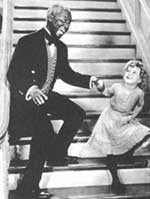
Shirley Temple and Bojangles Robinson

In those years the movie industry in Hollywood suffered mildly in comparison to the rest of America. Part of its success rested in its ability to create fantasy realms of song and dance that audiences could escape into and imagine as their own reality. So long as the Hollywood studios could produce these fanciful productions with talented stars, Depression audiences paid money to escape from the problems of the world around them.

In 1935 little Shirley Temple became 20th Century Fox's leading star at the box-office. Shirley was born in 1928, five years before me. She began her film career in 1932 at the age of three, and in 1934 skyrocketed to stardom in Bright Eyes, a feature film designed specifically for her talents. She received a special Academy Award in February 1935

Shirley left the film industry at the age of twelve. You can still see her re-formatted movies today or watch them from a DVD you might rent from Netflix. You can even see her sing and dance on You Tube: On The Good Ship Lollypop.

Her films were relatively cheap to make, allowing studios to make a fine profit. She made twenty-four films—almost all inspiring song and dance comedies. Those comedies often dealt with the vitality and hope young people had even during the Depression. Examples are Curly Top, Dimples and the Little series. 

In The Littlest Rebel (1935) Shirley Temple was paired with one of her favorite dance partners—Bill "Bojangles" Robinson. One of the most successful African American actors of the day, "Bojangles" became famous for his talented dance skills. Although hardly allowed to achieve the stardom that white actors could enjoy, "Bojangles" talents did not go completely unrecognized. In the movie Swing Time, Fred Astaire pays a tribute to "Bojangles" as he dances to "Bojangles of Harlem" in blackface (the first and only time Astaire performs in blackface in his film career). 

Judy Garland

Another famous star of the 1930s was Judy Garland. She was 11 years older than me, but was also born in Minnesota, up in Grand Rapids. Among the most famous films of the time was the MGM production of The Wizard of Oz with Judy Garland and an amazing cast of characters. Judy Garland was not the only star that the studio had to boast of however; its star role also included Mickey Rooney and the singing pair of Nelson Eddy and Jeanette MacDonald. Judy and Mickey starred in several musicals together, such as Babes in Arms and Babes on Broadway, offering a dose of adolescent promise to Depression-escaping audiences.
____________________

In one scene from my novel, The Twins, a wealthy gangster of the Twin Cities, Teddy Banks, is busy seducing Iva Tilden, Tillie's mother. Here's part of the phone call Banks made to invite Iva to view the newest Judy Garland film.

“Iva, good morning. How are you?” said the soft voice of Teddy in her ear.

She almost dropped the phone as well. “I . . . ah . . . I’m fine.”

“And did my flowers arrive?”

“Yes, yes. They are so wonderful. What can I say?”

“You can say yes to my invitation, dear lady. I want to take you to see that wonderful new fifteen year old actress we spoke about last Saturday. Remember Judy Garland?”

“Of course. I remember. You even told me she was born in Minnesota.”

“Ah. You do remember. And do you remember where in Minnesota she was born?”

Iva began to loosen up. “Yes, silly. She was born up north, in Grand Rapids, and her birth name was Frances Ethel Gumm.”

“Bravo, my dear. Bravo. Tomorrow night we shall go to see her in that movie I told you about,
“Broadway Melody of 1938,” and we’ll hear her sing the little song she first sang to Clark Gable himself.” Teddy began to sing the lines of the song, “You made me love you. I didn’t want to do it. I didn’t want to do it.”
_____________________

Well, Byron, you won't be reading my novels for a long time, but you may enjoy watching a Shirley Temple movie even now. If you do, think about me. 

Love, 

GGPa

Friday, February 10, 2012

Grandma's Icklegooey Sandwich

Dear Byron,

Yesterday your G-GMa and I were looking at some more of those old photos we have in albums and boxes here at our house. All that got me to thinking about my Grandma's Icklegooey Sandwiches. I thought you might want to ask your Grandma Cheryl to make you one some day.

Here's a photo of me holding your Great-Uncle Jeff, not long after he was born. You can tell he was still a very tiny baby. I'm standing between my Momma on the left and my Grandma Iva Turpen on the right. 

Grandma and my Grandpa Steve lived in West St. Paul, Minnesota on George St. in the same house in which my Momma grew up. Come to think of it, I don't know how long they lived there. At the time of this photo, 1958, my Grandpa had already gone to heaven and Grandma lived there by herself.

I spent many great hours in that house on George St. when I was a little kid. One of the neat things about George St. was the streetcar. I bet you've never heard of streetcars. Not many around any more. Most cities have fast mass-transit trains and subways. Those old streetcars were a lot more fun than the swift subways I've ridden on in New York or London. 

Interior of a Twin Cities Streetcar 
When I poked around on the web I actually found a site that tells all about those old streetcars in Minneapolis and St. Paul back in the days when I was a little kid. Here's their photo of one on the inside. Notice the seats covered with webbing instead of leather, cloth or plastic like modern day trains or trolleys. 

The driver collected dimes in that little box to his right. If you didn't have correct change he'd make some for you. Lots of times I'd ride with my Grandma to downtown St. Paul. In order to get there we'd have to get a piece of paper that said we could transfer to another streetcar that went right into the busy downtown streets. I'd follow her to the stores when she wanted to shop for a new blouse or  hat or some other such boring thing. 

The best part of those shopping trips, next to riding on the streetcar, was when we got back to the house on George St. where she would ask if I wanted an Icklegooey Sandwich. Yes! Bet you have never had one of those. Bet you don't even know what they are. Nobody sells 'em, you know. You have to make 'em in your own house. Here's how Grandma did it. 

Manual Meat Grinder
She'd get out her meat-grinder and attach it to the little kitchen table. It looked like this one that you can still buy today from Dinodirect. Next she'd find a couple hard boiled eggs, some pickles, several pieces of lunch meat, a couple radishes, slices of tomato and whatever else she found in her funny little refrigerator. She would grind it all up in her grinder and catch it in a bowl. Add some mayonnaise to the mixture and you're ready to make the sandwiches. By this time my mouth would be watering. 

OK, now pop some white bread into the toaster and when the toast pops up apply big globs of Icklegoeey and you're all set to go. We'd sit down at the little kitchen table with a big glass of orange pop to talk about the trip we had on the streetcar. Maybe we'd also plan to go to the movies in the evening when Grandpa Steve got home from working as an inspector at the South St. Paul Stockyards. Could anything possibly be better? 

I sure hope that you and your Grandma get to do some fun things like making Icklegooey Sandwiches. Just ask her. 


Saturday, February 4, 2012

The Spiral Bridge


Dear Byron,

I noticed recently that you are beginning to look at books and even trying to read them. I'm so happy to hear about that. I've loved books all my life. I have owned hundreds of them and still have many on my shelves here at our home.

I also suspect that as you grow up books will be printed less and less on paper. My guess is that most of the books you read will be on some kind of ebook reader like an iPad or Kindle. Its certainly a different world from when I grew up.

Last time I wrote to you, I showed you a photo of our farm. Well, that farm was about ten miles west of a town called Hastings. That town is right on the Mississippi River and has a bridge going over the river. Follow this link to the Little Log House Village, outside of Hastings a mile or so and their replica of the Spiral Bridge. I've been to the Village. It's quite a neat place. They have preserved many things from days gone by, like that old station wagon you see in front of their Spiral Bridge.

There actually was a real Spiral Bridge. It was built near the end of the nineteenth century to accomodate the horse-drawn vehicles of the day. Located where the present city of Hastings stands, it circled up from the bank on the Hastings side to a height sufficient to bring the wagons and carriages safely to the other. When I was a kid we would drive across that bridge to the other side of the river on our way up to St. Paul.

Many have been fascinated by pictures and tales of the old Spiral Bridge. Sad to say, it was torn down in 1951 and replaced with a more modern one. However, the spiral span still appears in the logo on Hastings vehicles and city stationery.

Spiral bridges are a rarity. State and Federal transportation and historic agency officials said they know of no other such bridge in the United States. Hazel Jacobsen Theel, who wrote a booklet about the old bridge, said she knew of only two other spiral bridges in the world, one located in Japan and the other in Germany.

The question of who designed the Hastings Spiral Bridge was debated in local newspapers in the 1940s. Several engineers, elevator owner John Meloy and a Hastings inventor, or their ancestors, all laid claim to the spiral design. All I know, is that it was kind of a neat bridge.

After you've learned to read and are a bit older, I'd like you to read the first novel that I ever wrote. Of all things, its called The Spiral Bridge. By the time you read it I'll have it out in an ebook format—just for you and all the other modern kids. 

Love ya, 

GPa